Services
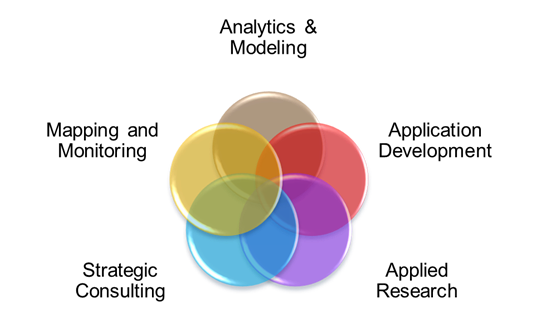
4DM provides services that are typically divided into consulting projects or service-based agreements. Service activities cover five core areas:
- Scientific and Engineering Support: Activities focus on providing technical services by combining 4DM expertise in science and engineering with geospatial information technology. Example include numerical modeling, data analysis, field verification and methodology development.
- Geospatial Information Technology Applications: Technical service activities include data building, spatial analytical solutions, and decision support information. Expertise covers areas such as GIS, remote sensing (optical, hyperspectral, thermal, LiDAR, radar, aerial), geodatabase, 2D/3D visualization, cartography, and geocoding.
- Software Development: Software design and development is geared toward creating custom solutions using .NET and Java technologies. Development experience includes GIS desktop applications using ArcObjects and Magik to web mapping decision support systems using Bing Mapping, Google, MapServer and ArcGIS Server
- Strategic Consulting: We provide clients with an understanding of how to apply geospatial technology to meet their needs. Examples include business analysis, technical direction, technology evaluation, development of standards, and gathering of user needs requirements of clients.
- Applied Research and Development: 4DM continues to develop innovative solutions via development of new methodologies, algorithms and decision support systems to enhance current services or develop new products.
Examples of Services

- Airborne LiDAR digital surface model of a dam.
- Water resource modeling – Conducting numerical modeling to determine surface runoff, flow direction, routing, hydrographs, predicting water levels, inundation flooding extent and water budgeting. 4DM staff are knowledgeable with a number of numerical models such as HEC-HMS, HEC-RAS, SWAT, and MIKE Flood.
- Snow transport modeling and snowdrifting mitigation – Conducting winter studies on highways and roads to assess the magnitude of snow flux and accumulation. 4DM uses this information to evaluate and design treatment for preventing snow accumulation on road ways.
- Terrain analysis – Applying remote sensing technology to derive topography, land cover types and digital surface models using optical high resolution sensors (GeoEye, QuickBird, IKONOS, WorldView), digital orthophotos (Vexcel DMS) and LiDAR data.
- Property rights mapping – Conducting title searching to identify property boundaries and interpretation to create geometry using coordinate geometry. Derived geometry data are then integrated with parcel data, orthophotos and other base mapping layers to provide decision support information.
- Custom decision support system development and hosting – Developing web-based geosolutions providing data capturing, interactive querying, visualization, and report generation.

- Custom web-based data catalog and mapping application.
- Dam failure inundation mapping and incremental hazard potential – Undertake hydrotechnical studies to determine extreme flow events (PMF), dam breach hydrographs and unsteady flow routing to produce inundation mapping for emergency preparedness plans. Modeling results used to estimate life, social-economic, environmental and cultural losses for dam hazard classification.
- Climate analysis – Determining climatic characteristics for areas of interest and defining storm frequency duration and intensity. Implementing climate change predictions to examine potential impacts and adaptation strategies.
- Environmental assessment support – Providing technical analysis, spatial modeling and cartographic products to be used in the environmental assessment process.
- Geotechnical and geological support – support erosion analysis, calculate overburden thickness, and create geological maps.
- Geodemographic analysis - applying census and financial data for trade area analysis
- General mapping and data processing support – 2D/3D mapping and visualization, image fusion and data building using GIS and CAD tools. In addition, LiDAR post processing, terrain modeling using 3D breaklines applied to LiDAR data, and orthorectification of satellite imagery.